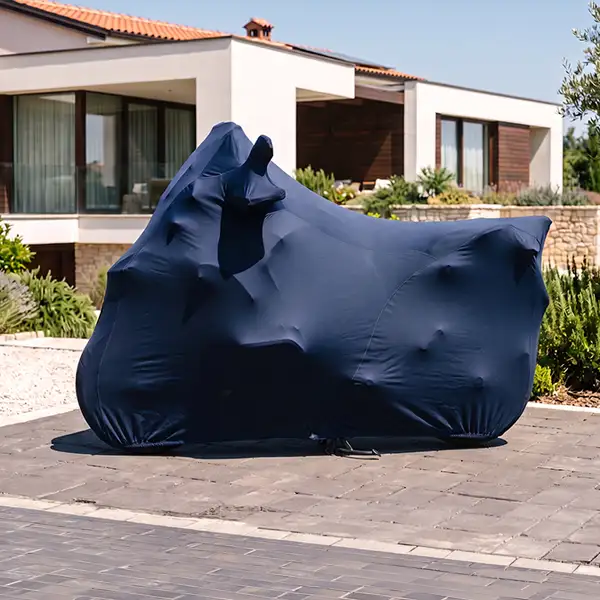
Personalised motorbike cover: a guide to materials and long-term care

In this article
telo-coprimoto-su-misura

Choosing a bespoke motorbike cover is a technical decision, not just an aesthetic one. The wrong fabric for the wrong conditions can be worse than no cover at all: it traps moisture, offers no protection from UV rays, or scratches the paintwork at the first gust of wind.

This guide covers every aspect — materials, finishes, use, washing — to help you choose exactly what your motorbike needs.

Why it is measured and not universal

Motorcycles have much more variable geometries than cars: the difference in shape between a naked bike, a sports bike, a maxi scooter and a custom bike is not a matter of centimetres, but of radically different proportions — handlebar height, tail length, fairing volume, and mirror position.

A universal ‘size M’ sheet has to cover all of this with a single pattern, and the result is always a compromise.

A made-to-measure motorbike cover, on the other hand, is made to the actual dimensions of that specific model: the fabric follows the shape of the fairing, wraps around the handlebars without any excess material, and extends down to just the right point on the sides without touching the ground or being too short.

This isn’t just a matter of aesthetics — it’s what determines whether or not the cover provides protection.

Technical specification

A motorcycle cover with 15 cm of excess fabric at the sides forms folds which, in moderate wind conditions (30–40 km/h), cause abrasive movement on the paintwork equivalent to approximately 200–300 rubbing strokes per hour of exposure.

Fabrics for outdoor use: what to look for

Outdoor use is the most demanding environment. The fabric must withstand UV radiation, rain, temperature fluctuations, organic deposits (resin, pollen, bird droppings) and mechanical stress caused by the wind, all at the same time. Choosing the right material determines whether the fabric actually provides protection or merely serves as a cover.
Polyurethane (PU) — Sofin outdoor fabric

Polyurethane is the material chosen for the Sofin range of outdoor motorbike covers.

This is a technical fabric with a PU coating that guarantees structural waterproofing — not achieved through a degradable surface treatment such as DWR, but integrated into the composition of the material itself.

This is the main advantage over fabrics that have only an external water-repellent finish: the waterproofing does not wear off with washing and does not require periodic re-impregnation to remain effective.

Polyurethane also has high UV resistance, making it suitable for prolonged outdoor storage without the bodywork suffering photochemical degradation of the paintwork.

The outer surface is resistant to mechanical abrasion caused by wind and atmospheric deposits — resin, sand, pollen — which, on a less compact fabric, would penetrate the fibres and cause deterioration from within.

Fabric for indoor use: bi-elastic fabric

In a garage or enclosed parking space, the priorities are completely different to those outdoors. There is no rain, UV exposure is non-existent or negligible, and wind is not a factor. What matters is how gently the tool comes into contact with the paintwork, its ability to mould to the contours without applying pressure, and protection from dust and accidental scratches.
Two-way stretch: 90% polyester / 10% elastomer

The Sofin indoor motorbike cover is made from a bi-elastic fabric comprising 90% polyester and 10% elastomer. The percentage of elastomer — the elastic component — is what sets this fabric apart from plain polyester: the cover does not simply rest on the motorbike, but moulds to its shape, exerting uniform tension across the entire surface. The result is continuous, controlled contact between the fabric and the bodywork, with no air pockets, no creases and no areas of abnormal pressure.

The high polyester content ensures dimensional stability, resistance to surface abrasion and ease of washing. The fabric’s surface is smooth and fine-textured — non-abrasive — making it safe to use even on delicate paintwork, chrome finishes and glossy plastics. Unlike microfibre, which traps dust in its fibres, this bi-elastic polyester fabric is easier to clean and retains its properties over time, even after repeated washing.

The bi-elastic design has a further practical advantage: it makes daily fitting and removal much easier. The cover slips over the motorbike, following its contours without the need for adjustments, and can be removed just as quickly. For those who use the cover every day before and after a ride, this feature is by no means insignificant.

Outdoor · Sofin

Engineering polyurethane (PU)

Structural waterproofing integrated into the material — not reliant on surface treatments that degrade over time. High UV protection for prolonged outdoor storage in all seasons.

UV protection: High
Abrasion resistance: High
Waterproofing: Structural (not DWR)
Re-impregnation: Not required

Indoor · Sofin

Technical bi-elastic fabric

90% polyester / 10% elastomer. Tailored fit to the shape of the motorbike, smooth, non-abrasive surface, suitable for everyday use.

Composition: 90% PES / 10% EL
Fit: Bi-elastic, contoured
Paint sensitivity: Very high
External use: Not recommended

How to choose the right fabric for your motorbike

The most important factor is not the type of motorbike, but the context in which it will be used. Before assessing the fabric, answer these three questions: will the motorbike be kept outdoors or in a garage? How long will it remain covered without being moved? What is the climate like where you live?

Motorcycle in the garage, for everyday use

The motorbike is uncovered almost every day. Protection from dust is the priority. The cover must be put on and taken off quickly without scratching the paintwork.

Bi-elastic · Sofin

Outdoor use, frequent use

The motorbike is parked outdoors but is used regularly. It needs protection from rain and UV rays without the need for periodic re-impregnation.

Polyurethane · Sofin

Outdoor seasonal storage

The motorbike is left outside for weeks or months. Maximum UV protection and long-lasting waterproofing with no maintenance required. The cover is not removed until the next season.

Polyurethane · Sofin

Vintage or high-end motorbikes in the garage

The original paintwork or hand-polished finish cannot withstand any risk of abrasion. The bi-elastic structure distributes tension evenly without creating any pressure points.

Bi-elastic · Sofin

Cold, damp weather; winter storage

Snow, persistent rain, sub-zero temperatures for months on end. Structural waterproofing is required that does not deteriorate in the cold and does not require seasonal maintenance.

Polyurethane · Sofin

Garage with fluctuating humidity levels

Unheated room with significant temperature fluctuations. The bi-elastic polyester fabric does not absorb ambient moisture in the same way as cotton and retains its properties even in unheated environments.

Bi-elastic · Sofin

PU vs DWR: two different approaches to waterproofing

Anyone looking for an outdoor motorbike cover often finds themselves faced with the issue of waterproofing — and the question of whether the treatment will last. It is worth understanding how the two main approaches on the market work, as the difference is significant.

How DWR works — and why it wears off

Most motorcycle covers on the market feature a DWR (Durable Water Repellent) treatment: a layer of fluorinated polymers applied to the surface that causes water to run off rather than be absorbed.

DWR works well when it’s new, but it’s a surface treatment — it isn’t integrated into the fabric fibres. It breaks down with exposure to UV light, heat and washing. After a season of intensive outdoor use or 20–30 washes, the water-repellent effect diminishes significantly and the fabric begins to absorb water rather than allowing it to run off.

The standard solution is to re-impregnate the fabric periodically using specialised sprays: a process that takes time, requires an additional product and demands a certain degree of care in how it is applied. It must be repeated regularly throughout the fabric’s lifetime. This is not a fault in itself — it is simply how the technology works.

The signal that the DWR has been exhausted
Pour a few drops of water onto the surface of the fabric. If round droplets form and roll off, the treatment is still active. If the fabric absorbs the water and darkens, the DWR has worn off and the fabric is not providing adequate protection from the rain — even if it looks intact.

The polyurethane approach: maintenance-free waterproofing

The Sofin outdoor motorbike cover is made from technical polyurethane. The PU is not a surface treatment: the material itself is waterproof by virtue of its chemical composition. Water does not penetrate because it cannot pass through the fabric’s structure — not because a surface layer temporarily repels it. The practical result is that the waterproofing does not wear off with washing and does not require periodic re-impregnation. There is no maintenance procedure to follow to keep the protection active: the cover performs just as well on first use as it does after three years of outdoor use. Anyone searching for ‘how to re-impregnate a motorbike cover’ is looking for a solution to a problem that simply does not exist with a PU cover.
IN A NUTSHELL

Fabrics with DWR treatment: good water resistance initially, but require periodic re-impregnation to remain effective.

SOFIN polyurethane membrane: structurally waterproof, no additional maintenance required, consistent performance over time.

UV protection: filter integrated into the PU
When it comes to UV rays, the principle is the same. Fabrics with a surface-applied UV-protective treatment gradually lose their effectiveness with prolonged exposure to the sun — the very agent that the filter is designed to block contributes to its degradation. In technical polyurethane, UV resistance is an inherent property of the material, not of an additional coating. This makes it particularly suitable for prolonged outdoor storage — the very situation in which UV protection is most critical and must last the longest.

How to wash your motorbike cover: instructions for PU and bi-elastic fabrics

Incorrect washing is the main cause of premature wear and tear in technical fabrics. The instructions vary depending on the material: PU and bi-elastic fabrics have different compositions and react differently to heat, detergents and the spin cycle.
guidelines applicable to both materials

Never use fabric softeners. The silicones contained in fabric softeners build up on the fibres, irreversibly altering the properties of the fabric — on bi-elastic fabrics, they compromise elasticity; on PU fabrics, they can damage the surface coating.

Washing the polyurethane sheet (for outdoor use)

1

Remove solid dirt without using water

Shake out the cover and remove leaves, insects and solid debris with a soft brush. Do not wet dry dirt: it turns to mud, which sticks to the PU surface during washing.

2

Hand wash or machine wash at 30°C on a gentle cycle

Neutral liquid detergent, free from enzymes and optical brighteners. Spin at a maximum of 400 rpm — a high-speed spin cycle may cause the PU coating to warp at the folds. If the sheet is very large, hand washing in a basin with cold water is preferable.

3

Rinse thoroughly

Detergent residue on the PU surface can leave streaks and reduce the water’s ability to run off. Rinse until the water runs completely clear.

4

Air-dry, away from direct sunlight

Lay the cover flat or hang it up without any localised tension. Avoid using a tumble dryer: the high heat can damage the PU coating. Do not expose it to direct sunlight whilst drying — prolonged exposure to UV light, without the motorcycle’s body to protect the inner side, accelerates the material’s deterioration.

5

No re-impregnation required

Unlike fabrics with a DWR finish, polyurethane does not require re-waterproofing sprays after washing. Its waterproofing is structural and remains unchanged regardless of how many times it is washed.

Washing the bi-elastic fabric (for indoor use)

1

Remove dry dust

Shake out the towel or brush the surface gently with a soft brush. The polyester bi-elastic fabric tends to trap fine dust on the surface — removing it dry before washing prevents it from becoming embedded in the fibres when wet.

2

Standard rinse

One rinse cycle is sufficient. Detergent residue on polyester does not cause the same problems as it does on fabrics with active treatments — but a thorough rinse helps keep the fabric softer over time.

3

Machine wash at 30°C, gentle cycle

Liquid detergent for delicate or synthetic fabrics. The elastomeric component (10%) is heat-sensitive: do not exceed 30°C and always use the delicate cycle. Spin at a maximum of 600 rpm — above this threshold, the heat generated by friction and mechanical twisting will gradually reduce the fabric’s elasticity.

4

Air-dry or tumble dry at a low temperature

The polyester bi-elastic fabric dries quickly in the air. If you use a tumble dryer, set it to the lowest available temperature (40°C max): moderate heat does not damage the polyester, but higher temperatures degrade the elastomer, reducing the fabric’s ability to return to its original shape.

5

Storage without permanent creases

Bielastic fabric has elastic memory — if it is stored folded at the same points for long periods, those areas will gradually lose their tension. Fold the fabric differently each time you wash it, or store it rolled up rather than folded.

Create your own bespoke motorbike cover

Select the type of fabric based on its intended use, colour and size. The cover is manufactured in Italy to the exact dimensions of your vehicle and delivered directly to your home.